How to set KPIs that motivate collaboration
This is a shorter version of the newsletter. To get the full version with tips, follow-ups, and introductions of other members, subscribe to our mailing list:
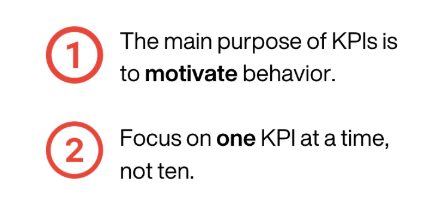
This is a short note based on my training “Goal setting in partnerships”. For now, here’s a sneak peek into a section on KPIs. You only need to remember two key points before we start:
Why don’t partnerships have clear KPIs?
They disagree about purpose and avoid addressing these disagreements or may not know how to resolve them.
They do not know how to measure the desired outcome and stick to easy metrics. This is problematic because measurement drives behavior: people focus on achieving what’s measured, not necessarily what's truly matter.
What are the most common problems with KPIs?
Their absence. Here are my top 5:
No rewards for achieving KPIs.
People do not have full control over the outcome. For example, “Increase funding by 20%” is flawed if it depends more on donors than the NGO employee’s actions.
Overly complex measurements. When it’s unclear how to improve a KPI, like “Increase customer satisfaction,” people struggle to act effectively.
KPIs drive competition and pit partners against each other because the rewards are not shared and inclusive.
Simple metrics are unfair for smaller organizations and can disadvantage and demotivate them.
I cover all these challenges and solutions in my workshop. For now, let me share a tip to address one aspect: how to use KPIs to motivate collaborative behavior. For more insights, check out Behn’s chapter, “Linking Measurement to Motivation.”
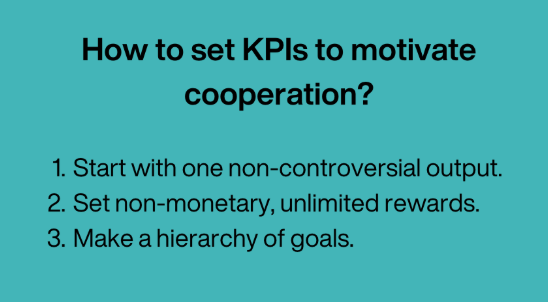
Step 1: Start with one measure only
Think about the behavior you need to motivate. Behn suggests, “Start by thinking about motivation instead of measurement. Your measurements might be complex if you want to evaluate, but if you want to motivate—keep them simple.”
What are the outputs of this behavior? Ensure they depend on effort, not on external circumstances (see the funding example above).
Choose a noncontroversial output. It should not create disagreements and will serve as the foundation for the next steps. For example, in schools, improved math scores are a good starting measure, whereas implementing standardized tests for sexual education is not.
Decide how to measure it: mean, median, or percentile? Each method motivates different behaviors. Behn provides a great example: If a school uses average scores to track progress, every student’s score matters equally, so teachers focus on students most likely to improve. If the bottom 10th-percentile score is used, only improvements from the lowest-performing students count, encouraging teachers to focus on those struggling the most.
Focus on progress, not absolute results. For instance, “5% increase in tasks finished on time” is better than “95% of tasks finished on time.”
Set a realistic maximum standard. For example, expecting 100% of projects to be completed on time and within budget is often unrealistic, so aim for achievable targets.
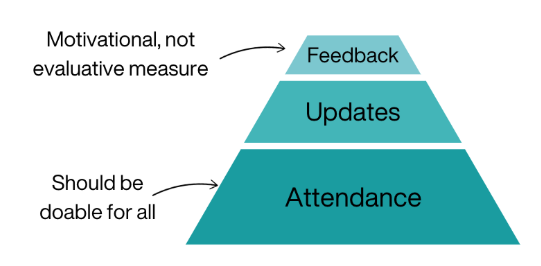
A poor evaluative measure can still be an excellent motivational measure. Behn provides a great example: daily attendance in schools. While daily attendance is a terrible evaluative measure—it reflects neither outcomes nor outputs—it is a strong motivational tool. Increasing attendance encourages schools to take meaningful actions, like making school more engaging, collaborating with parents, and improving the learning environment - and it will improve the quality of education too.
Don’t worry if your motivational measure feels simplistic—you’ll add more indicators in Step 3.
Step 2: Set Rewards
Avoid monetary rewards. They don’t work for motivation and often make things worse in the long run. There’s plenty of research proving the ineffectiveness of monetary incentives, yet managers still insist on using them. Just don’t. There are many alternatives; Behn provides a nice and counterintuitive example: ask the “winners” to help the “losers.” Instead of rewarding top performers with money, give them additional responsibility by asking them to support those who are struggling. This approach achieves two things:
It transforms top performers into role models, leaders, and heroes.
It creates a valuable learning loop within the team.
Reward team behavior to encourage team behavior. For instance, offer recognition or awards for achieving shared goals of the working group or a whole partnership. A district might receive an award when all its schools reach a maximum achievable standard in daily attendance.
Don’t arbitrarily limit the number of winners. For example, if you only reward the top five performers, you risk fostering competition and harming motivation. If you’re not using monetary rewards—and you shouldn’t—there’s no reason to limit recognition. This way, you encourage collaboration rather than competition.
Step 3: Create a hierarchy of goals
What comes next after achieving the maximum standard for your first, simple goal? Repeat the first two steps to build a hierarchy of goals. This approach allows you to tailor KPIs to organizations of different sizes and stages of development, avoiding “winners” and “losers” while fostering a sense of progress.
Use the hierarchy as a path for improvement. Once you’ve completed these three steps, set achievable goals for the next period for each partner or working group. Start with measure #1, gradually increasing their targets until they reach the maximum achievable standard. Then, move on to measure #2 in your hierarchy, and so on. It does not have to be complicated, here is an example from a large information-sharing network:
Increase event attendance by 10% each quarter until at least 80% of partners attend each event for three consecutive sessions.
Prepare Minutes of Meetings within two days of each event and encourage attendees to share them with their directors or decision-makers.
Run quarterly surveys for directors and decision-makers within the organizations, aiming for a 40% response rate.
Once the hierarchy of goals is in place, consider what other measures you need. These additional measures aren’t rewarded—they’re used to monitor for any unintended or unforeseen outcomes.